
Hail Damage Roof Repair
Capture the homeowners searching after hail hits their area, document the damage for the insurance claim, and win the repair or replacement before another roofer answers the call.

Free Hail Damage Search Audit
Most roofing sites have no page built for hail damage searches in their storm region. Get a free audit with a competitor comparison and a content plan that captures the surge after a storm.
What Is Hail Damage Roof Repair?
Hail damage roof repair is the inspection, documentation, and restoration of a roof struck by hail, where ice pellets knock granules off shingles, bruise the mat, and dent metal components.
Granule Loss
Impact knocks the protective granules off asphalt shingles, exposing the mat to UV and speeding the path to leaks and failure.
Shingle Bruising
A hail strike creates a soft spot in the shingle that does not break the surface but accelerates deterioration over the following months.
Dented Metal and Flashing
Vents, gutters, downspouts, and flashing show dents, and damaged flashing opens a pathway for water to enter the structure.
How Does Hail Damage a Roof?
Hail damages a roof when ice pellets strike with enough force to compromise the protective layers, with severity set by hail size, wind speed, roof age, and material.
The Force Behind the Strike
- Larger stones and higher wind speeds carry more energy into the surface.
- An older or brittle roof absorbs less impact and damages more easily.
- Material composition decides whether a strike bruises, cracks, or punctures.
The Danger Is Hidden
- Much of the damage sits beneath the surface and is missed from the ground.
- Bruised areas worsen with each later rain and freeze cycle.
- Storm pages tie to the seasonal calendar. See seasonal SEO for roofers.
What Are the Signs of Hail Damage?
The signs of hail damage are soft spots, dark patches of missing granules, cracked or punctured shingles, dents on metal parts, and granules washed into the gutters.
On the Shingles
Soft, spongy spots under light pressure, dark patches where granules are gone, and visible cracks, tears, or punctures.
On Metal and in Gutters
Dents on vents, gutters, flashing, and downspouts, plus a heavy build-up of loose granules washed into the gutters.
A Random Pattern
Hail damage scatters across the roof along the storm's path, rather than following the predictable wear pattern of age.
Be the First Roofer They Find
After a hailstorm, homeowners search within hours. A page built for hail damage in your service area puts your company in front of them before the door-knockers arrive.
Call Now For PricingOr call +1 272-207-3231
How Is a Hail Damage Inspection Done?
A hail damage inspection follows a fixed sequence: an exterior check of every roof plane, an attic check for intrusion, photo documentation, and a written report.
The Four-Step Protocol
- Exterior assessment across all roof planes and slopes.
- Attic inspection for water intrusion and structural damage.
- High-resolution photos from multiple angles with the damage marked.
- A written report with repair recommendations and a cost estimate.
Marking for the Adjuster
Inspectors chalk test squares and build a visual map of the strikes so the insurance adjuster can verify the damage. A roof inspection page can rank for the homeowner researching this step. See roof inspection.
How Does the Hail Damage Insurance Claim Work?
The hail damage insurance claim works in four steps: document the storm, get a professional inspection, file promptly, and have the contractor present for the adjuster visit.
The Filing Steps
- Record the storm date and time and pull the official weather report confirming hail size.
- Get a detailed photo report and written assessment from a roofer.
- Contact the insurer within days; many policies require filing within one year.
- Have the contractor present during the adjuster's inspection.
Mistakes That Sink a Claim
- Reporting after the policy window has closed.
- Thin photo documentation that the adjuster can dispute.
- Accepting the first settlement without review.
- Making repairs before the adjuster inspects. See insurance restoration.
Repair or Replace After Hail?
The repair-or-replace call turns on how much of the roof is hit, how old it is, and what the insurance coverage allows. Localized, minor damage points to repair; widespread bruising points to replacement.
Repair Makes Sense When
- Localized damage covers less than 30 percent of the surface.
- The roof is under 10 years old.
- Strikes are isolated and matching shingles are available.
- A single storm caused minor granule loss. See roof repair.
Replacement Makes Sense When
- Bruising is widespread across multiple planes.
- The roof exceeds 15 years old.
- There is a history of repeated storm damage.
- Insurance has approved the replacement. See roof replacement.
What Does Hail Damage Repair Cost?
A full hail replacement commonly runs 8,000 to 15,000 dollars, with the figure driven by roof size, pitch, material, and the extent of the damage. Localized repairs cost far less.
What Drives the Price
- Roof size and pitch, where steeper slopes raise labor 20 to 40 percent.
- Material, with asphalt the most affordable and metal, tile, and slate higher.
- Extra components such as gutters, vents, and flashing add 15 to 30 percent.
- Regional pricing varies 30 to 50 percent by location.
Coverage Shapes the Out-of-Pocket
- Replacement Cost coverage pays for new materials regardless of roof age.
- Actual Cash Value depreciates for the roof's remaining lifespan.
- The deductible is the amount due before coverage applies.
- Material choice matters across the roof. See roofing materials.
Organic Storm Leads Cost Less Than Paid Ones
A click earned from a strong organic hail page costs nothing per visit, against 50 to 150 dollars for shared storm leads. Build the page once and capture the surge after every storm.
Call Now For PricingOr call +1 272-207-3231
How to Tell Hail Damage From Normal Wear
Hail damage and normal wear read differently: hail leaves random circular impact marks with fresh, sharp edges, while wear shows uniform, gradual decline along seams and edges.
Hail Damage Looks Like
- Random impact marks scattered across the surface.
- Fresh cracks with sharp edges and compressed fibers.
- Circular or elliptical granule loss in irregular patterns.
- Damage to several roof components at once.
Normal Wear Looks Like
- Uniform deterioration over the whole roof.
- Gradual granule loss in valleys and along edges.
- Linear cracks along seams and stress points.
- Algae or moss in shaded areas, consistent with age.
Do Impact-Resistant Shingles Help?
Impact-resistant shingles help because Class 4 products meet the UL 2218 standard, resist hail up to about two inches, and can earn an insurance premium discount.
What Class 4 Delivers
- Meets UL 2218 Class 4, the highest impact-resistance rating.
- Resists hail up to roughly two inches in diameter.
- Costs 10 to 20 percent more than standard architectural shingles.
- Often carries an extended warranty with high wind resistance.
A Discount Worth Naming
Many insurers offer a premium discount in the 10 to 35 percent range for Class 4 shingles, a selling point worth raising on a replacement quote. See architectural shingles.
How Does Hail Search Behavior Move After a Storm?
Hail search behavior moves in waves: emergency queries spike in the first days, claim research follows in the next two weeks, and contractor comparison takes over by week three.
Days 1 to 3
Emergency and immediate repair searches spike. An emergency page and a tarp-and-secure message catch this first wave.
Days 4 to 14
Assessment and insurance claim queries rise. A claim-process page meets the homeowner working through the paperwork.
Weeks 3 to 6
Focus shifts to contractor selection and cost comparison. Reviews and a clear quote process win this stage. See local SEO for roofers.
How to Rank a Hail Damage Page in Your Region
Rank a hail damage page by naming the storm regions you serve, answering the claim questions in full, and linking the page to the storm and local silos.
Build the Page for Intent
- Name the counties and cities where hail hits your service area.
- Answer the inspection, claim, and repair-or-replace questions on the page.
- Show storm job photos and reviews from homeowners you helped.
- Add a tarp-and-secure section for the first-wave emergency search.
Wire It Into the Silo
- Link up to the storm damage parent page in the trade silo.
- Cross-link the seasonal and local SEO method guides.
- Keep the page live year round so it ranks before the next storm. See storm damage roofing.
Proof of Performance
Results from roofing campaigns that rank in local search.

Map Pack Rankings
Ranked in Local Search Within 90 Days
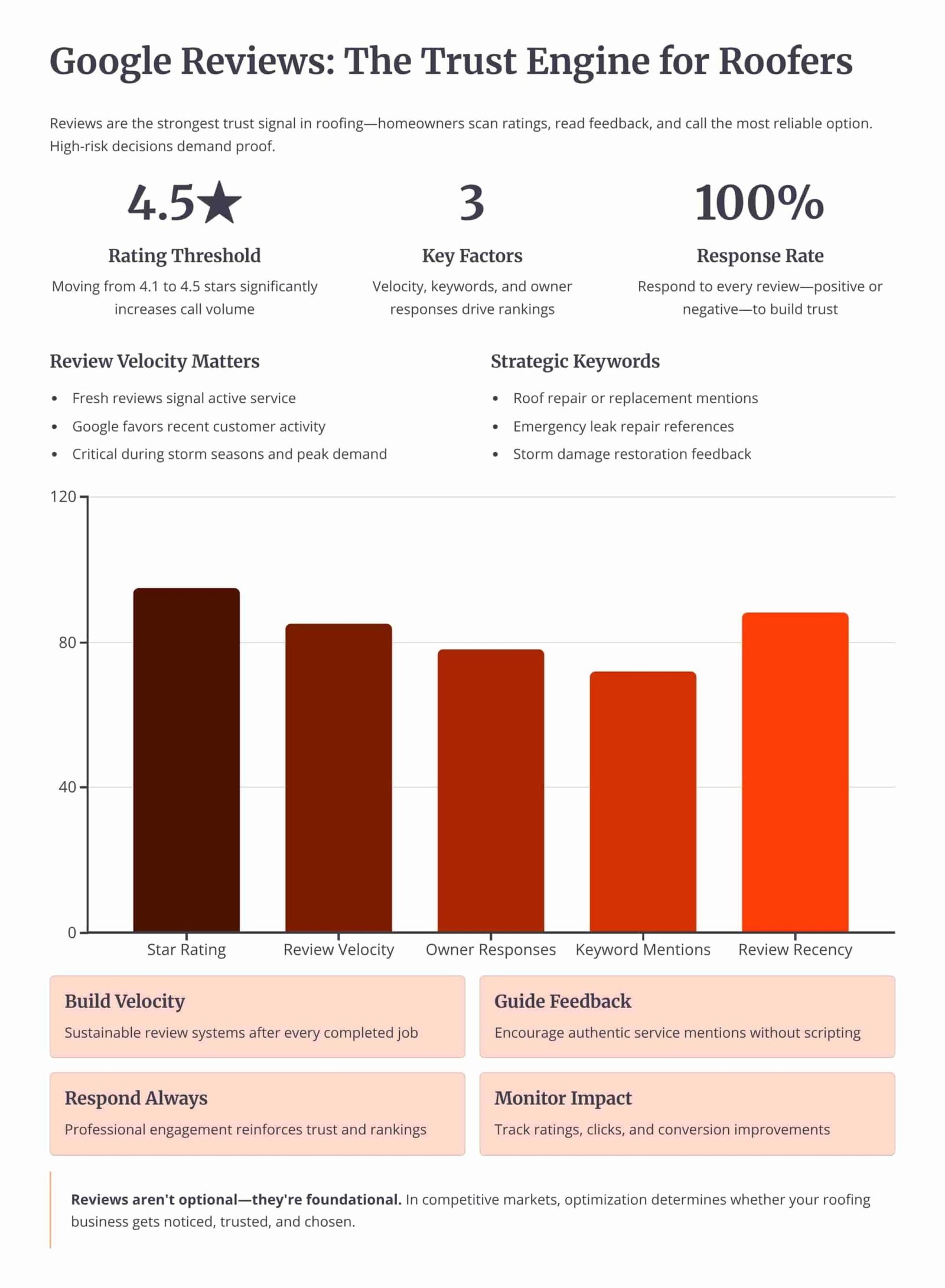
Review Velocity
150+ 5-Star Reviews Generated

Organic Traffic
300% Increase in Qualified Traffic
What Roofers Say
The 180-Day Roofing SEO Roadmap
See how we optimize the profile, build the website, and earn local-pack rankings over a 6-month engagement.
Month 1: Profile Audit and Setup
- Category and Field Fixes: Setting the primary category, secondary categories, description, services, and service areas.
- NAP Cleanup: Correcting the name, address, and phone number across the profile, the website, and the directory citations.
Month 2: Reviews and Media
- Review System: Setting up a steady request flow and replying to every review, positive and negative.
- Photo and Post Cadence: Uploading job photos from each completed roof and publishing profile posts twice a month.
Month 4: Citations and Site Support
- Citation Building: Adding consistent listings on the directories that feed prominence for a service area.
- Service-Area Pages: Building city pages on the website that reinforce the profile's service areas.
Month 6: Local-Pack Rankings and Leads
- Map-Pack Position: Reaching the top 3 of the local pack for core roofing queries in the served cities.
- Lead Tracking: Measuring calls and direction requests from the profile against the cost of paid leads.
Owning Search Demand vs Renting It From Lead Platforms
If you pay Angi or Google Ads, you are renting visibility. The moment you stop paying, your pipeline dries up. Ranking the profile and the website for high-intent local searches builds permanent digital equity.
Shared Lead Platforms (Angi, HomeAdvisor)
- The Race to the Bottom: Shared leads force you to slash prices to win against 5 other roofers.
- Low Intent: Half the time they aren't ready to buy, they were just clicking around online.
Local Search SEO (Our Approach)
- 100% exclusive, direct-to-you inbound calls.
- Highest closing rate. They chose YOU from the local pack.
- Compounding ROI. You don't pay per click.
We Identify Search Intent Using Industry-Leading Data Tools




Expertise Built on Data.
Not Guesswork.
I'm Nizam Ud Deen, and I don't build generic websites. I build search intent engines specifically for the roofing industry.
For years, I've watched roofers burn money on agencies that brag about "traffic" while the phones stay silent. Traffic without intent is worthless. My system maps exactly how homeowners search during storms, when comparing prices, and when they're ready to buy, and intercepts them at every stage.
The No-Brainer Roofing SEO Guarantee
We don't guarantee "traffic" or "rankings." We guarantee high-intent leads.
"We guarantee to generate 15 exclusive, inbound replacement or repair leads per month within the first 180 days, driven entirely by high-intent organic search. If we don't hit that metric, we work for free until we do."
Measuring Success: Leads and Revenue
We don't report on vanity metrics. If traffic goes up but revenue stays flat, the strategy failed. We track the pipeline.
Call Tracking
Every keyword mapped to the exact phone call it generated.
Form Fills
Tracking estimate requests from high-intent local landing pages.
Booked Jobs
Connecting CRM data to SEO efforts to prove actual revenue return.
Cost per Lead
Monitoring organic CPL to ensure it beats shared platform costs.
The Hail Damage Page Checklist
Run a hail damage page through this checklist to confirm it captures the storm search and earns the call.
Frequently Asked Questions
Clear answers about hail damage roof repair and the searches around it.
What is hail damage roof repair?
How do I know if my roof has hail damage?
Does insurance cover hail damage to a roof?
How long do I have to file a hail damage claim?
Should I repair or replace a hail-damaged roof?
How much does hail damage roof repair cost?
What is the difference between hail damage and normal wear?
Should I make repairs before the adjuster inspects?
Do impact-resistant shingles prevent hail damage?
How do different roofing materials respond to hail?
Does unrepaired hail damage affect home resale?
How should a roofer tarp a roof after hail?
Which regions get the most hail damage?
How does a roofer rank for hail damage searches?
Get Your Free Hail Damage Search Audit
We'll check whether your site can capture hail damage searches in your storm region and compare you to the top 3 local competitors to show where the lead slips away.
What You Get:
- Storm Page ReviewA check of whether a hail page exists and answers the claim and repair questions.
- Region Coverage ScanA list of the storm regions and cities your pages name versus the ones they miss.
More Deliverables
- Intent Timeline MapWhich pages catch the emergency, claim, and comparison waves after a storm.
- Content OutlineA drafted hail page outline built around your highest-risk storm regions.
Claim your free hail damage search audit today. No commitment required.