
Roofing SEO Success Factors: What Actually Drives Rankings, Leads, and Signed Contracts!
You have invested in SEO. You have updated your website. You may even be publishing roofing content. But the phone is still quiet while competitors dominate the Google Map Pack.
Roofing SEO success does not come from generic tactics or random content updates. It comes from understanding the specific factors that influence local rankings, Google Maps visibility, customer trust, and high-intent roofing searches.
Imagine knowing exactly what drives roofing rankings, what converts visibility into real leads, and how to position your business where homeowners and property managers are ready to hire.
Discover the proven roofing SEO success factors that turn search visibility into consistent calls, inspections, and signed roofing contracts.

Why Most Roofers Do SEO But Miss the Real Success Factors That Drive Leads?
Here’s the uncomfortable truth: most roofing contractors approach SEO like they’re checking boxes on a generic marketing checklist. They build a website, stuff it with keywords, maybe write a blog post or two, and wonder why the leads never materialize. The problem isn’t effort, it’s understanding.
Roofing SEO isn’t a single tactic. It’s not just “getting on Google.” It’s a complete system where local relevance, trust signals, technical performance, content depth, and measurement work together to turn searches into signed contracts. When one component fails, the entire system underperforms. When all components align, you dominate your service area and your phone rings with qualified leads ready to buy.
The System Approach:
Roofing SEO succeeds when Local SEO + Trust + Technical Foundation + Content Depth + Measurement work as one integrated system, not isolated tactics.
Many failures happen because contractors never clearly define what they are trying to achieve. Understanding what is roofing SEO helps clarify that it is not generic SEO, but a local, trust-driven system designed to capture near-me, emergency, and high-intent roofing searches.
Success depends on understanding what Google rewards in the roofing industry specifically, and what homeowners need to see before they trust you with a $15,000+ investment in their most valuable asset. This guide breaks down the eight non-negotiable success factors that separate roofing companies drowning in leads from those wondering why SEO “doesn’t work.”
Many roofing companies think SEO is just keywords and backlinks, but real growth comes from understanding the full system behind rankings and lead generation. Our Roofing SEO framework breaks down how local visibility, trust signals, content depth, and conversion systems work together to turn search traffic into signed roofing contracts.
Success Factors for Clear Local Relevance. Matching “Near Me” Search Intent
One of the most critical Roofing SEO Success Factors is clear local relevance. Roofing searches are driven by urgency and proximity. When a homeowner discovers a roof leak at 2 AM during a storm, they are not searching for a generic roofing company. They search for “emergency roof repair near me” or “roofer in [city].”
Google’s local algorithm prioritizes businesses that most closely match this near-me intent because roofing is an inherently local service. Homeowners want fast response times, nearby crews, and proven local presence, not a contractor located hours away.
Service Area Clarity
Your website must explicitly state which cities, ZIP codes, and neighborhoods you serve. Vague language like “serving the greater metro area” doesn’t cut it. Google needs clear signals.
Location Pages Strategy
Create dedicated pages for each service area with unique, valuable content, not thin doorway pages that duplicate the same template with city names swapped.
On-Page Local Signals
Title tags, headers, schema markup, and embedded maps must all reinforce your local relevance. Every page should answer: “Where do you serve?”
Local relevance isn’t just about rankings, it’s about producing calls from people in your actual service area who can become customers. A roofing company ranking #1 for searches 50 miles outside their service zone generates zero revenue. Precision matters more than volume.
Key Takeaway: Local relevance equals rankings that produce calls from customers you can actually serve.
Managing multiple branches requires careful structure to avoid ranking conflicts. Proven approaches for roofing SEO for multi-location roofers focus on service area clarity, location pages, and preventing keyword cannibalization across cities.
Google Business Profile Strength. A Core Roofing SEO Success Factor for Map Pack Visibility
Google Business Profile strength is one of the most critical Roofing SEO Success Factors when competing for Map Pack placement. The Google Map Pack. those three businesses displayed above organic results with maps, reviews, and direct call actions. represents the highest-intent traffic in local roofing searches. This placement captures users who are actively ready to book inspections, request estimates, or call a contractor immediately.
From a search intent perspective, Map Pack dominance is driven by relevance accuracy, proximity signals, and prominence indicators such as reviews, engagement, and profile completeness. Industry studies consistently show that Map Pack listings attract more clicks and calls than the number one organic ranking for local service queries. When your roofing business is not present in this section, your visibility drops sharply at the exact moment customers are making hiring decisions.
Strengthening your Google Business Profile through category alignment, service optimization, media engagement, and reputation signals transforms it into a ranking asset. As a Roofing SEO Success Factor, Map Pack visibility directly determines whether your business is discovered first. or not discovered at all.
Consistency Across Platforms
Your business name, address, and phone number (NAP) must match exactly across your website, Google Business Profile, and all citation sources. Even minor inconsistencies confuse Google and hurt rankings.
Categories, Services & Settings
Your primary category must be “Roofing Contractor.” Add secondary categories like “Roof Repair Service” or “Commercial Roofing Contractor” if applicable. Configure your service area settings to match where you actually work, not the entire state.
GBP Content Optimization
Upload high-quality photos of completed projects, your team, and your trucks. Post weekly updates about services, seasonal offers, or storm damage alerts. Answer every question in the Q&A section with keyword-rich, helpful responses.
10-Point GBP Must-Have Checklist
- Primary category: Roofing Contractor
- Complete business description with keywords
- Service area properly configured
- 20+ high-quality photos uploaded
- Weekly posts published
- All Q&A questions answered
- Business hours accurate and updated
- Services list fully populated
- Attributes selected (veteran-owned, etc.)
- NAP consistency verified
Trust & Reputation Success Factors That Win Roofing Leads
Trust and reputation are core Success Factors in Roofing Google Maps visibility and buyer decision-making. Roofing is a high-stakes purchase. Homeowners are trusting you with their largest asset and projects that often range from $15,000 to $50,000 or more. At this decision stage, searchers are not choosing the first listing they see. They choose the roofing company that demonstrates credibility, consistency, and proof.
Google’s local algorithm mirrors this behavior. Review volume, review velocity, response quality, and overall sentiment are powerful trust signals that directly influence Map Pack rankings. Strong reputation signals increase prominence, improve click-through rates, and validate your business as a reliable local provider. When reviews, owner responses, and profile engagement align, they reinforce one of the most important Roofing Google Maps SEO Success Factors. Being the roofing company both Google and customers trust to deliver.
87%
Consumer Trust
87% of consumers read online reviews for local businesses before making a decision
4.0+
Minimum Rating
Roofing companies need at least a 4.0-star average to compete in competitive markets
50+
Review Volume
Top-ranking roofers typically have 50+ Google reviews with consistent monthly growth
Review Volume, Recency & Response Strategy
It’s not enough to have reviews, you need recent reviews. Google prioritizes businesses with consistent review velocity (new reviews every month). Respond to every review, positive or negative, within 24-48 hours. Your responses show potential customers how you handle feedback and problems.
Proof Assets: Case Studies, Galleries & Credentials
Your website must showcase before/after photo galleries, detailed case studies of complex projects, and clear displays of licenses, insurance, manufacturer certifications, and industry memberships. These proof elements satisfy Google’s E-E-A-T requirements (Experience, Expertise, Authoritativeness, Trustworthiness) for high-stakes industries.
Remember: Roofers don’t win on traffic volume, they win on trust. A website with 1,000 visitors and strong trust signals will outperform a site with 5,000 visitors and weak credibility.
Technical Foundation Success Factors: Speed, Mobile UX & Crawlability
A strong technical foundation is one of the most critical Roofing SEO success factors because it directly influences how Google evaluates, ranks, and presents your website in search results. Site speed, mobile usability, and crawlability determine whether your pages are eligible to compete, especially in local and high-intent roofing searches.
Google relies on Core Web Vitals to measure real-world performance, while mobile-first indexing prioritizes the mobile version of your site as the primary ranking reference. When your website loads slowly, displays poorly on mobile devices, or blocks search engines from efficiently crawling key service pages, rankings decline and lead flow suffers. Even the strongest content and keyword targeting cannot overcome weak technical signals.
Core Web Vitals
Largest Contentful Paint (LCP) under 2.5 seconds, First Input Delay (FID) under 100ms, and Cumulative Layout Shift (CLS) under 0.1. These metrics measure loading speed, interactivity, and visual stability.
Indexation & Crawl Health
Submit XML sitemaps, configure robots.txt properly, fix canonical tag issues, and eliminate crawl errors. Google can’t rank pages it can’t find or understand.
Site Architecture
Organize content in clear silos: Services → Locations → Resources. Use hub-and-spoke linking to connect related pages and distribute authority throughout your site.
Technical Red Flags That Kill Rankings
Slow site: Pages taking 5+ seconds to load on mobile
Broken pages: 404 errors on important service or location pages
Duplicate location pages:> Same content with only city names changed
Messy navigation: Confusing menu structure that buries important pages
No HTTPS: Insecure sites lose trust and rankings
Mobile issues: Text too small, buttons too close, horizontal scrolling
Technical SEO isn’t glamorous, but it’s foundational. Think of it as the roof deck, if it’s rotten, nothing you build on top will hold. Fix technical issues first, then layer on content and links. For detailed technical optimization strategies, explore our Technical SEO guide.
Service Depth Content as a Core Roofing SEO Success Factor!
Service depth content is one of the most overlooked Roofing SEO Success Factors. Broad, generic “roofing services” pages fail because they lack intent alignment and topical coverage. Google prioritizes content that demonstrates real expertise by addressing the exact problems, decisions, and concerns customers have at the moment they search.
To compete in local and organic results, your content must fully map to customer intent. That means covering emergency roof repairs, material comparisons, installation methods, lifespan expectations, warranty considerations, and realistic cost ranges. When your pages answer these questions clearly and comprehensively, they send strong relevance and authority signals to search engines while guiding homeowners toward confident hiring decisions.
Money Pages: The Services That Generate Revenue
Create dedicated, in-depth pages for your core revenue-generating services: roof repair, roof replacement, emergency roof repair, storm damage restoration, insurance claim assistance, and roof inspections. Each page should be 1,500+ words with detailed explanations, process breakdowns, pricing guidance, and clear calls-to-action.
Emergency Services
24/7 emergency repair content targeting urgent, high-intent searches with immediate response promises.
Storm restoration companies rely on speed, visibility, and trust during peak demand windows. Implementing systems designed for roofing SEO for storm restoration companies allows roofers to capture emergency searches, insurance-related traffic, and local map pack visibility when storms hit.
Replacement Projects
Complete replacement guides covering materials, timelines, costs, and what homeowners should expect.
Residential roofing companies depend heavily on homeowner-driven searches like replacements and inspections. Implementing strategies tailored to roofing SEO for residential roofers ensures service pages align with homeowner intent, trust expectations, and local search behavior.
Commercial Roofing
Separate content path for commercial clients with TPO, EPDM, and metal roofing expertise.
Commercial roofing SEO requires longer sales cycles, higher trust thresholds, and authority-driven content. Specialized strategies outlined in roofing SEO for commercial roofers help contractors rank for high-value commercial searches and attract decision-makers instead of low-quality leads.
Supporting Pages: Answer Objections Before They Call
Build supporting content that addresses common questions and objections: “How much does a new roof cost?”, “How long does roof replacement take?”, “What’s the best roofing material for my climate?”, “Do I need a permit?”, “What does my warranty cover?” This content builds trust, captures long-tail searches, and pre-qualifies leads.
Your content must answer roofing objections before prospects pick up the phone. The more educated they are, the more qualified they are as leads.
Authority Signals as Roofing SEO Success Factors. Backlinks & Local Mentions!
Authority signals are core Roofing SEO Success Factors that influence how Google evaluates trust, prominence, and competitive strength in local search results. Backlinks remain one of Google’s strongest ranking signals, but in the roofing industry, relevance and locality determine real impact. A citation or backlink from a local chamber of commerce, supplier network, roofing association, or manufacturer contractor directory sends far stronger trust signals than dozens of low-quality links from unrelated websites.
These authority-driven success factors reinforce your legitimacy in a specific service area, helping Google confidently position your roofing business in Map results and organic listings. High-quality local mentions signal real-world presence, industry validation, and brand credibility. That combination improves visibility for high-intent searches and supports long-term ranking stability in competitive roofing markets.
Local Link Building
Chamber of commerce memberships, local business associations, supplier partnerships, sponsorships of community events, and local news coverage
Industry Authority Links
National Roofing Contractors Association (NRCA), manufacturer certification directories (GAF, Owens Corning, CertainTeed), Better Business Bureau
Avoid Toxic Tactics
Never buy links, participate in link schemes, or use automated link building. Google penalizes these tactics and recovery is painful
Building Local Authority
Focus on earning mentions and links from local sources: get featured in local news for storm response, sponsor Little League teams, join your chamber, partner with local real estate agents and insurance adjusters. These local signals tell Google you’re a legitimate, established business in your community.
Industry Credibility
Pursue manufacturer certifications and get listed in their contractor directories. Join industry associations and get listed on their member directories. These authoritative industry links signal expertise and trustworthiness to both Google and potential customers.
Conversion System. Roofing SEO Success Factors That Drive Signed Contracts
Here’s the reality most agencies avoid. Roofing SEO success factors are not measured by rankings alone, they are measured by booked inspections, signed contracts, and revenue growth. You can dominate page one and appear in the Local Pack for every roofing keyword in your market, yet still lose money when your website fails to convert visitors into calls or your intake process fails to turn calls into qualified estimates.
True conversion-focused SEO aligns visibility with buyer intent. That means call-driven page layouts, trust signals that reduce friction, and a sales flow designed to move prospects from Google Maps and organic search into real conversations. Without these success factors in place, rankings stay cosmetic and SEO spend turns into an expense instead of a predictable growth system.
Search
Homeowner searches “roof repair near me” or “emergency roofer [city]”
Discovery
Finds your Google Business Profile or website in search results
Contact
Calls your number or submits a form requesting an estimate
Inspection
You schedule and complete an on-site inspection and provide a detailed quote
Contract
Customer signs contract and you schedule the roofing project
Emergency Intent UX
For emergency searches (roof leak, storm damage), your website must provide instant access to your phone number, preferably with a sticky header that follows users as they scroll. Emergency searchers won’t fill out forms; they need to talk to someone immediately.
Trust Placement for Conversions
Place trust elements strategically throughout your site: display review stars and counts near CTAs, show license numbers and insurance badges in the footer and contact pages, feature recent project photos on service pages. Trust elements reduce friction and increase conversion rates by 20-40%.
Measurement & Feedback Loops. A Core Success Factor in ROI-Driven Roofing SEO
Among the most overlooked Roofing SEO Success Factors is accurate measurement. When performance is not tracked correctly, optimization decisions are based on assumptions rather than data. Roofing contractors often invest in SEO without visibility into what is driving calls, form fills, and booked estimates, which makes it impossible to scale what works or correct what does not.
Measurement and feedback loops act as a success factor because they connect rankings, Google Maps visibility, traffic, and conversions to real revenue outcomes. With proper tracking in place, every optimization can be evaluated, refined, and aligned with ROI. This is what separates high-performing roofing SEO campaigns from costly experiments. Data-backed insights allow continuous improvement, smarter budget allocation, and clear proof of growth from your SEO investment.
Call Tracking & Form Tracking
Implement call tracking numbers that attribute calls to specific marketing sources and keywords. Use form tracking to capture lead source data in your CRM. Without this attribution, you’re flying blind, you know leads are coming in, but you don’t know which SEO efforts are generating them.
Lead Source & Keyword Attribution
Track which keywords and pages generate the most valuable leads. Not all traffic is equal, a visitor from “emergency roof repair [city]” is worth 10x more than someone searching “roofing tips.” Focus your SEO efforts on high-value keywords that drive qualified leads.
Metrics That Actually Matter
Forget vanity metrics like total traffic or keyword rankings. Focus on business metrics: cost per lead (CPL), lead-to-customer close rate, average job value, and total revenue attributed to SEO. These numbers tell you whether SEO is profitable, not just whether it’s “working.”
ROI Calculation Formula
Monthly SEO Leads × Close Rate × Average Job Value = Monthly Revenue from SEO
Example: 20 leads × 30% close rate × $12,000 avg job = $72,000/month revenue
If you're spending $2,500/month on SEO, your ROI is 2,780%
Tracking performance is meaningless without understanding return on investment. Measuring roofing SEO ROI helps roofing companies connect rankings and traffic to real outcomes like booked inspections, signed contracts, and revenue growth.
Common Reasons Roofing SEO Fails (And How to Fix Them)
Understanding what makes roofing SEO succeed is only half the battle. You also need to recognize the common failure patterns that sabotage results, even when contractors think they’re “doing SEO.” These failures aren’t about bad luck; they’re about fundamental misunderstandings of how the system works.
Generic SEO Approach
Using the same SEO tactics that work for e-commerce or SaaS companies. Roofing requires local-first, trust-heavy, conversion-focused strategies that generic agencies don’t understand.
Fix: Work with specialists who understand roofing customer behavior and local service business SEO.
Weak Google Business Profile
Incomplete GBP with few photos, no posts, inconsistent NAP data, or wrong service area settings. The Map Pack is where roofing leads come from,neglecting GBP is SEO suicide.
Fix: Optimize every GBP element and maintain it weekly with posts, photos, and Q&A responses.
No Reviews or Review Velocity
Either no reviews at all, or a handful of old reviews with nothing recent. Google prioritizes businesses with consistent review growth.
Fix: Implement a systematic review request process for every completed job. Aim for 3-5 new reviews monthly.
Thin Service Pages
Generic 200-word pages that say “We offer roof repair” with no depth, no answers to customer questions, and no differentiation from competitors.
Fix: Expand service pages to 1,500+ words covering process, pricing, materials, timelines, and FAQs.
No Location Targeting
Website mentions “serving the area” without specifying cities, neighborhoods, or ZIP codes. Google can’t rank you locally if you don’t signal local relevance.
Fix: Create dedicated location pages for each city/area you serve with unique, valuable content.
Inconsistent Effort
Starting and stopping SEO based on how busy you are. SEO compounds over time—stopping and restarting wastes previous investments.
Fix: Commit to 12+ months of consistent SEO effort. Results accelerate after 6-9 months of sustained work.
Inconsistent Effort
Starting and stopping SEO based on how busy you are. SEO compounds over time—stopping and restarting wastes previous investments.
Fix: Commit to 12+ months of consistent SEO effort. Results accelerate after 6-9 months of sustained work.
One of the biggest reasons roofing SEO fails is applying a generic SEO strategy to a local, service-based industry. Understanding the differences between roofing SEO vs general SEO helps contractors avoid wasted effort and focus on local relevance, map pack dominance, and conversion-focused traffic.
Most failures follow predictable patterns that can be avoided. Understanding roofing SEO mistakes helps contractors identify weak foundations, broken local signals, and conversion gaps before they waste months of effort and budget.
Roofing SEO Success Checklist: Your Implementation Roadmap
Use this comprehensive checklist to audit your current SEO efforts and identify gaps. Each checked item represents a success factor in place. Unchecked items are opportunities for improvement that could unlock better rankings and more leads.
Foundation Elements
- Google Business Profile fully optimized with accurate NAP
- Primary category set to “Roofing Contractor”
- Service area properly configured in GBP
- 20+ high-quality photos uploaded to GBP
- Weekly GBP posts published consistently
- All Q&A questions answered in GBP
- 50+ Google reviews with 4.0+ star average
- New reviews coming in monthly (review velocity)
- All reviews responded to within 48 hours
- NAP consistency across all citations
Technical Performance
- Core Web Vitals passing (LCP, FID, CLS)
- Mobile-friendly design with responsive layout
- HTTPS security certificate installed
- XML sitemap submitted to Google Search Console
- No crawl errors or indexation issues
- Canonical tags properly implemented
- Clear site architecture with logical navigation
- Page load speed under 3 seconds on mobile
Content & Local SEO
- Dedicated location pages for each service area
- Location pages have unique, valuable content (not templates)
- Service pages are 1,500+ words with comprehensive info
- Emergency repair page optimized for urgent searches
- Supporting content answers common customer questions
- Before/after photo galleries showcasing work
- Case studies demonstrating expertise
- License, insurance, and certification info displayed
- Schema markup implemented (Service, Review, FAQ)
Authority & Conversion
- Links from local chambers and business associations
- Listed in manufacturer contractor directories
- Click-to-call phone number on every page
- Above-the-fold CTAs on all service pages
- Short, optimized contact forms (5 fields or fewer)
- Trust elements placed near CTAs (reviews, badges)
- Call tracking system implemented
- Form tracking integrated with CRM
- Monthly reporting on leads, CPL, and ROI
Scoring Guide: 30+ checked items = Strong foundation | 20-29 = Moderate gaps | Under 20 = Significant opportunities for improvement.
Before implementing advanced strategies, roofing companies need a strong understanding of how SEO actually works in the roofing industry. The Roofing SEO fundamentals cover the core concepts, systems, and principles that every roofer must understand before expecting rankings, leads, or long-term results.
The Local SEO Success Factor: Why "Near Me" Searches Win
Local SEO isn’t just one of the success factors—it’s the foundation everything else builds on. Understanding why local signals dominate roofing SEO helps you prioritize efforts and avoid wasting time on tactics that don’t move the needle for service businesses.
Local Search Intent
97% of roofing searches include local intent—city names, "near me," or ZIP codes
Service Area Targeting
Google matches searchers with businesses that explicitly serve their location
Mobile-First Behavior
76% of roofing searches happen on mobile devices with immediate intent
Map Pack Dominance
Map Pack listings get 44% of clicks for local service searches
When someone searches “roof repair near me” at 10 PM because they discovered a leak, they’re not browsing, they’re buying. They need a roofer who serves their area, can respond quickly, and appears trustworthy. Local SEO optimization ensures you appear for these high-intent, high-value searches.
Your local SEO strategy must address three core elements: proximity (how close you are to the searcher), relevance (how well your business matches the search), and prominence (how well-known and trusted your business is), Master these three elements and you dominate local roofing searches.
Roofing searches are driven by urgency, proximity, and trust far more than most industries. This is why why roofing SEO is different matters. Near-me intent, emergency behavior, and reputation signals play a much larger role in determining which roofing companies win local visibility.
Trust Signals: The Hidden Ranking Factor Google Won't Tell You About
Google’s algorithm includes hundreds of ranking factors, but one category matters more for roofing than almost any other industry: trust signals. Because roofing involves high-stakes decisions, significant financial investment, and potential safety issues, Google prioritizes businesses that demonstrate trustworthiness through multiple signals.
Credentials & Licensing
Display your contractor license number, insurance certificates, manufacturer certifications, and industry association memberships prominently. These credentials satisfy Google’s E-E-A-T requirements for YMYL (Your Money Your Life) industries.
Review Signals
Review quantity, quality, recency, and response rate all contribute to trust. Google analyzes review content for authenticity, diversity of reviewers, and consistency of positive feedback over time.
Proof of Work
Extensive photo galleries, detailed case studies, and video testimonials demonstrate real experience and expertise. These proof elements reduce bounce rates and increase time on site, both positive ranking signals.
The Trust Stack Effect
Individual trust signals matter, but the compound effect of multiple trust signals working together creates exponential impact. A roofing company with 100+ reviews, manufacturer certifications, 10 years in business, BBB accreditation, and extensive photo galleries doesn’t just rank slightly better, they dominate their market because the trust stack is unassailable.
Building trust takes time, but it creates a moat around your business that competitors can’t easily cross. New roofing companies can’t manufacture 10 years of reviews and project history. This is why established roofers who invest in trust-building SEO maintain dominant positions for years.
Learn more about building trust signals in our Trust & Reputation guide.
Content Depth vs. Content Volume: Quality Wins in Roofing SEO
One of the biggest misconceptions in roofing SEO is that more content automatically equals better rankings. Contractors see competitors with 50+ blog posts and assume they need to match that volume. But in roofing SEO, depth beats volume every time.
The Depth Approach
Create 10-15 comprehensive, authoritative pages that thoroughly cover your core services and service areas. Each page should be 1,500-3,000 words, answer every customer question, include photos and examples, and provide genuine value.
Benefits:
- Higher rankings for competitive keywords
- Better conversion rates (educated visitors)
- Easier to maintain and update
- Stronger topical authority signals
- More backlink attraction
The Volume Approach
Publish 50+ thin blog posts about roofing tips, seasonal maintenance, and tangentially related topics. Each post is 500-800 words with surface-level information.
Drawbacks:
- Dilutes site authority across many weak pages
- Lower conversion rates (informational traffic)
- Requires constant content production
- Difficult to maintain quality
- Attracts wrong type of traffic
3.8x
Conversion Rate
Comprehensive service pages convert 3.8x better than thin pages
2,000+
Optimal Length
Top-ranking roofing service pages average 2,000+ words
67%
Time Savings
Depth-first strategy requires 67% less ongoing content production
Focus your content efforts on the pages that generate revenue: service pages and location pages. Make these pages so comprehensive and valuable that they become the definitive resource for that topic in your market. Then, and only then, consider adding supporting blog content.
The Timeline Reality: When SEO Success Factors Start Working!
Understanding when different success factors produce results helps set realistic expectations and maintain consistent effort during the lag period before SEO compounds. Different elements of your SEO system activate at different times.
Months 1-2: Foundation
GBP optimization, technical fixes, and NAP consistency produce quick wins. You may see Map Pack improvements within 2-4 weeks.
Months 3-4: Momentum
Content and on-page optimization start ranking for long-tail keywords. Review velocity begins impacting local rankings.
Months 5-6: Traction
Authority signals (links, mentions) strengthen domain authority. You start ranking for competitive service keywords.
Months 7-9: Acceleration
Compound effects kick in. Multiple success factors working together produce exponential results. Lead volume increases significantly.
Months 10-12: Dominance
Market leadership position established. You rank for most target keywords and dominate Map Pack. ROI peaks.
The biggest mistake roofing contractors make is stopping SEO at month 4 or 5 because they don’t see explosive results yet. This is exactly when the compound effects are about to kick in. SEO is a long-term investment that rewards patience and consistency.
Most roofing companies quit SEO right before it would have started working. The ones who persist through months 1-6 reap the rewards for years.
Many roofers quit SEO too early because they misunderstand how results compound over time. A realistic roofing SEO timeline explains when foundation work, momentum, traction, and dominance phases actually begin to impact lead flow.
Measuring Success: The Metrics That Actually Matter
Vanity metrics like keyword rankings and total traffic feel good but don’t pay bills. Roofing SEO success must be measured in business outcomes: leads generated, cost per lead, close rates, and revenue attributed to organic search. Here’s how to track what matters.
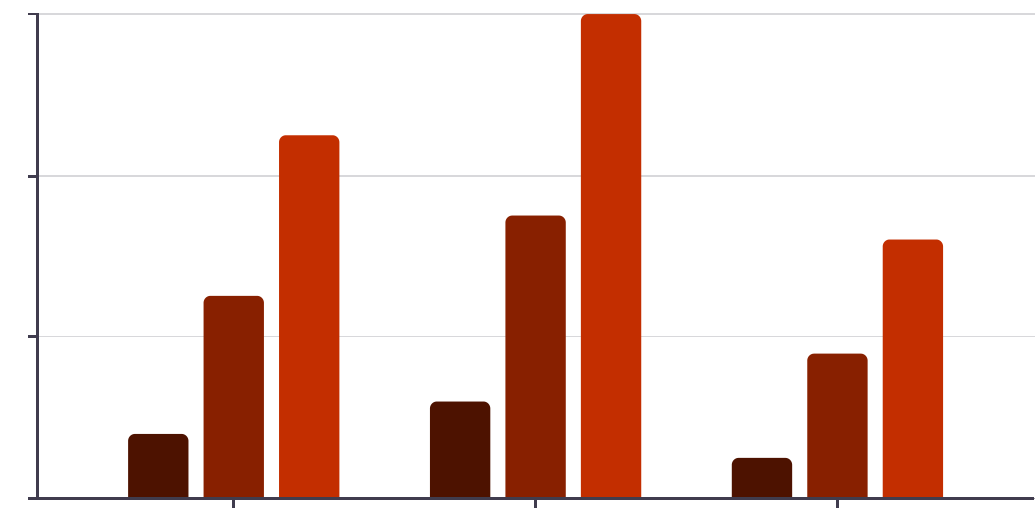
This chart shows typical lead growth trajectory for a roofing company implementing all success factors consistently. Notice the acceleration after month 6 when compound effects activate.
Lead Volume & Quality
Track total leads from organic search and Map Pack, but also track lead quality scores. A lead requesting emergency repair is worth more than someone asking about maintenance tips.
Cost Per Lead (CPL)
Divide your monthly SEO investment by leads generated. Target CPL should be 50-70% lower than paid advertising CPL within 6-9 months.
Close Rate by Source
Track which traffic sources (GBP, organic, direct) produce the highest close rates. Optimize for sources that convert best, not just sources with highest volume.
Revenue Attribution
The ultimate metric: total revenue from customers who found you through organic search. This proves ROI and justifies continued investment.
Set up monthly reporting that tracks these metrics over time. Share reports with your team to maintain buy-in and celebrate progress. When everyone sees the revenue impact, SEO becomes a priority instead of an afterthought.
Competitive Analysis. Identifying the SEO Success Factors That Drive Rankings
You can’t improve performance without understanding what drives results in your local market. Competitive analysis uncovers the SEO success factors that top-ranking roofing companies have already mastered. From Google Maps visibility signals to content depth, authority, and reputation strength. More importantly, it exposes where your competitors are strong and where strategic gaps exist that you can exploit.
What to Analyze in Competitor SEO?
Map Pack Position
- Who ranks in top 3 for target searches?
- How many reviews do they have?
- What’s their review velocity?
- How complete is their GBP?
Organic Rankings
- Which competitors rank for money keywords?
- What’s their content depth?
- How many location pages do they have?
- What’s their site structure?
Authority Signals
- What’s their domain authority?
- Where are their backlinks from?
- What local citations do they have?
- What certifications do they display?
Finding Your Competitive Advantage
Most roofing markets have 2-3 dominant players who’ve invested heavily in SEO, 5-10 mid-tier competitors with partial SEO implementation, and dozens of small players with minimal online presence. Your goal isn’t to beat everyone, it’s to identify the success factors where you can gain ground quickly.
Review Gap Opportunity
If top competitors have 150+ reviews and you have 30, closing this gap becomes priority #1. Implement aggressive review generation.
Content Depth Opportunity
If competitors have thin service pages, creating comprehensive 2,000+ word pages gives you an immediate advantage.
Location Coverage Opportunity
If competitors don’t have dedicated pages for specific neighborhoods or suburbs you serve, create them and dominate those micro-markets.
Competitive analysis isn’t about copying what others do, it’s about finding gaps in their strategy and exploiting them. The best opportunities are often in success factors competitors have neglected.
Choosing an SEO Partner: Evaluating Agencies & Consultants
Not all SEO providers understand roofing. Many agencies apply generic tactics that work for e-commerce or SaaS but fail spectacularly for local service businesses. Choosing the right partner can accelerate your success; choosing the wrong one wastes money and time you can’t recover.
SEO strategies must align with how roofing contractors actually operate in the field. A clear understanding of roofing SEO for contractors helps business owners evaluate whether an SEO partner understands job cycles, service areas, inspections, and lead-to-contract workflows.
Green Flags: What to Look For
- Specific roofing or home services experience
- Case studies with measurable results (leads, revenue)
- Transparent reporting on business metrics, not just rankings
- Local SEO expertise (GBP, citations, reviews)
- Custom strategy based on your market, not templates
- Realistic timeline expectations (6–12 months)
- Clear explanation of their process and tactics
Red Flags: What to Avoid
Guaranteed #1 rankings (impossible to guarantee) Cheap monthly fees ($500 or less—you get what you pay for) Focus on keyword rankings instead of leads/revenue Vague answers about tactics and strategy No call tracking or lead attribution Cookie-cutter approach (same plan for every client) Pressure to sign long-term contracts immediately
Questions to Ask Potential SEO Partners!
- What roofing companies have you worked with, and what results did you achieve? (Demand specifics: lead volume, revenue, timeframe)
- How do you approach local SEO differently than national SEO? (Tests their understanding of local search dynamics)
- What does your review generation strategy look like? (Critical for roofing success)
- How do you track and report on leads and revenue, not just rankings? (Separates results-focused agencies from vanity metric chasers)
- What’s your typical timeline for seeing meaningful results? (Anyone promising results in 30-60 days is lying)
- Can I speak with 2-3 current roofing clients? (If they won’t provide references, walk away)
For guidance on typical investment levels and what to expect, review our Roofing SEO Cost guide.
Ready to Implement These Success Factors?
You now understand the eight non-negotiable success factors that make roofing SEO work: local relevance, Google Business Profile strength, trust and reputation, technical foundation, service depth content, authority signals, conversion optimization, and measurement systems. The question isn’t whether these factors work—they do. The question is whether you’ll implement them consistently for the 6-12 months required to see transformational results.
Start With Your Foundation
Audit your current state using the checklist in this guide. Identify your biggest gaps, usually GBP optimization, review generation, or content depth. Fix foundational issues before layering on advanced tactics.
Commit to Consistency
SEO rewards sustained effort over time. Commit to 12 months of consistent implementation. The contractors who dominate their markets didn’t get there with 3 months of effort, they built momentum over years.
Measure What Matters
Set up proper tracking from day one. Implement call tracking, form tracking, and lead attribution so you can prove ROI and optimize based on data, not guesses.
Get Expert Help
Unless you have in-house SEO expertise, partner with specialists who understand roofing SEO specifically. The right partner accelerates results and avoids costly mistakes.
Your Next Steps
- Don’t let this guide become another piece of content you read and forget. Take action today:
- Complete the success factor checklist and identify your top 3 gaps
- Audit your Google Business Profile and implement the 10-point must-have list
- Review your service pages and commit to expanding your weakest page to 1,500+ words
- Set up call tracking if you don’t have it already
- Schedule a competitive analysis to understand your market position
The roofing companies dominating organic search in your market aren’t smarter or luckier, they simply implemented these success factors before you did. The opportunity is still there. The question is: will you take it?
Want to know which success factors you’re missing? Roofer Quest Consultancy offers free competitive audits that identify your biggest opportunities for improvement. We’ll show you exactly where you’re losing leads to competitors, and how to fix it.