
Roofing SEO for Storm Restoration Companies! SEO Strategies Built for Storm, Hail, and Insurance Claim Searches!Capture Every Storm Lead
Emergency SEO protocols that put your phone on ring the moment hail hits.
Roofing SEO for Storm Restoration Companies is built for one reality. When storms hit, homeowners do not wait. They search immediately for emergency help, and the companies that appear first get the calls. Ranking months later means missing the opportunity entirely.
Storm-related searches behave differently from normal roofing queries. Homeowners search with urgency using phrases tied to emergency repairs, storm damage, and insurance claims. Roofing SEO Companies focuses on these high-intent moments, ensuring your business appears when people need help right now.
Many storm restoration projects are insurance-driven. Our Roofing SEO strategies target searches related to insurance claims, coverage, and damage assessments, placing your company directly in front of homeowners actively seeking qualified restoration professionals. At the same time, we protect your local visibility by helping you outrank out-of-state contractors who rush into storm-hit areas after disasters.
Do not let storms pass while competitors capture the demand. Use Roofing SEO for Companies designed to rank fast, build trust quickly, and connect you with homeowners at the exact moment they are ready to hire.
Ready to Fix Your Roofing SEO?
Stop losing leads to competitors. Capture your market share today.
Why Storm Restoration SEO Is Different From Standard Roofing SEO?
Storm restoration companies experience firsthand why roofing SEO is different from other industries. Homeowners search under stress, Google prioritizes proximity and trust, and rankings can shift rapidly after severe weather. These factors demand specialized strategies that go far beyond standard SEO playbooks.
Standard Roofing SEO
- Steady, predictable demand
- Long sales cycles
- Price-focused searches
- General contractor queries
- Months to see results
Storm Restoration SEO
- Demand comes in spikes after weather events
- Urgent, same-day decisions
- Insurance-intent searches
- Trust signals matter more
- Need to rank fast during storm windows
Before diving into storm-specific strategies, it’s important to understand what is roofing SEO at its core. Roofing SEO focuses on ranking service businesses in local search results, but storm restoration SEO adds layers of urgency, insurance intent, and rapid response requirements that standard roofing campaigns do not face.
Storm restoration SEO is event-driven, urgency-driven, and insurance-driven. When hail hits or hurricanes strike, homeowners aren’t browsing, they’re panicking. They need emergency tarping tonight, an inspection tomorrow, and help filing their insurance claim this week. Your SEO strategy must capture this high-stress, high-intent traffic before storm chasers and out-of-state contractors flood Google Ads and Local Service Ads.
Competition spikes alongside demand. After a major storm, your local market transforms overnight. Contractors from three states away set up temporary operations, LSAs saturate the map pack, and paid ads drive up cost-per-click.
The roofing companies that win are those who already own the organic rankings for emergency roof repair, hail damage inspection, and insurance claim support searches. Standard roofing SEO focuses on steady lead generation over months. Storm restoration SEO requires a system that ranks fast, converts stressed homeowners immediately, and captures insurance-intent keywords that standard roofers ignore.
Storm restoration companies operate in a completely different search environment compared to standard roofing businesses. While traditional Roofing SEO services focus on steady local demand, storm restoration SEO must handle sudden demand spikes, emergency intent, and insurance-driven searches. That difference is why storm-focused strategies require faster indexing, stronger trust signals, and hyper-local visibility during critical response windows.
The difference between storm restoration SEO and traditional marketing becomes clear when comparing Roofing SEO vs general SEO. General SEO focuses on broad visibility, while roofing SEO prioritizes proximity, emergency intent, and trust signals. Storm restoration SEO intensifies these factors, especially during active weather events.
The Storm Restoration Search Funnel: What People Search Before They Call
Each stage requires different content and conversion messaging. Immediate urgency searches need click-to-call buttons, emergency availability messaging, and same-day inspection booking.
Damage evaluation searches need educational content with photos showing what hail damage, wind damage, or water intrusion looks like. Insurance help searches need guides explaining the claim process, adjuster interactions, and documentation requirements.
Contractor selection searches need trust signals: reviews, licensing proof, before-and-after galleries, and case studies showing successful insurance claim support.
Immediate Urgency
"roof tarp service"
"same day roof leak repair"
"24 hour emergency roofer"
Damage Evaluation
"wind damage shingles"
"how to tell if roof is damaged"
"missing shingles after storm"
Insurance Help
"how to file roof claim"
"roof insurance claim process"
"roofing supplements"
Contractor Selection
"best roofer for insurance claims"
"licensed storm restoration contractor"
"hail damage roofing company"
Understanding how homeowners search after a storm starts with mastering the Roofing SEO fundamentals. From initial panic searches to insurance-related queries and contractor comparisons, storm restoration SEO depends on aligning content with each stage of the funnel. Without a solid foundation, even high-intent traffic can fail to convert into booked inspections.
Ready to Dominate Your Local Market?
Call Now For PricingKeywords That Actually Bring Storm Restoration Jobs
Storm restoration keywords fall into distinct clusters, each representing different homeowner needs and conversion potential. The most valuable keywords combine storm damage types, service urgency, insurance intent, and local modifiers. Generic “roofer near me” searches bring competition from every contractor in your market. Storm-specific keywords bring homeowners who need your specialized services right now.
Emergency + Same-Day
- emergency roof repair near me
- 24 hour emergency roofer
- same day roof tarp service
- emergency roof leak repair
- roof tarping service near me
Storm Damage Type
- hail damage roof repair [city]
- wind damage roofing contractor
- hurricane roof damage repair
- tornado damage roofer
- storm damage roof inspection
Insurance + Claim Help
- roofing insurance claim help
- roofer that works with insurance
- insurance claim roof inspection
- roof claim supplement specialist
- insurance restoration roofer
Local Modifiers
- [storm type] roof repair [city]
- storm damage roofer [neighborhood]
- [city] hail damage roofing
- emergency roofer [ZIP code]
- [county] storm restoration contractor
.
Keyword Formula for Storm Restoration
- [Storm Type] + roof repair + [City]: Example: “hail damage roof repair Dallas”
- emergency + roofer + near me: Captures immediate urgency with local intent
- insurance claim + roofing + [City]: Example: “insurance claim roofing Fort Worth”
- [Damage Type] + [Service] + [Location]: Example: “wind damage shingle replacement Plano”
- [Storm Name] + roof damage + [City]: Example: “Hurricane Ian roof damage Naples” (rapid response)
Local SEO for Storm Damage Roofers: Map Pack Dominance
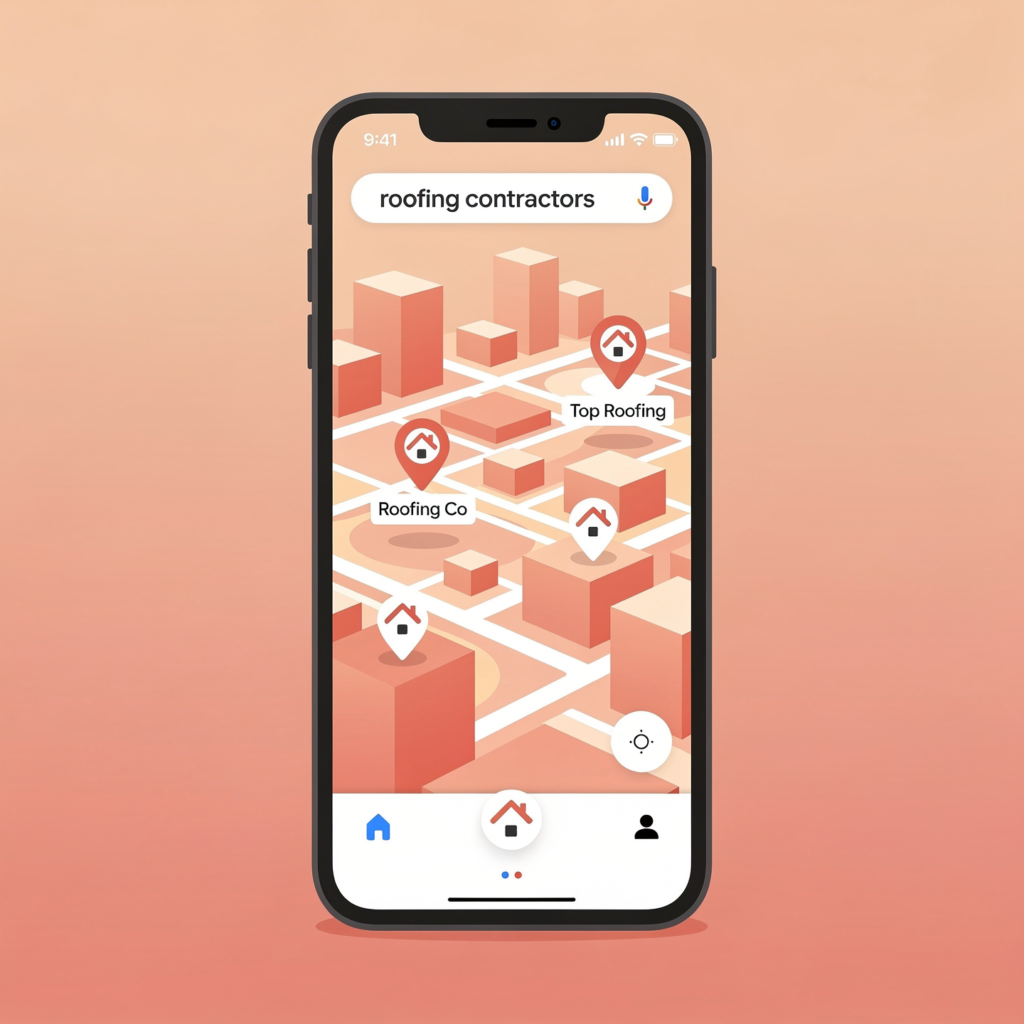
The Google Map Pack is where storm restoration jobs are won or lost. When homeowners search “emergency roof repair near me” or “hail damage roofer [city]” on their phones, they’re looking at the top three map results. If you’re not in that pack, you’re invisible to the highest-intent leads in your market. Storm restoration local SEO requires aggressive optimization of your Google Business Profile, strategic service area targeting, and proof that you’re the trusted local expert when disaster strikes.
Google Business Profile Optimization for Emergency Services
Your GBP must communicate emergency availability, storm damage expertise, and insurance claim support. Add “Emergency Roof Repair,” “Storm Damage Inspection,” “Hail Damage Repair,” and “Insurance Restoration” as primary services. Update your business description to include “24/7 emergency response,” “same-day tarping,” and “insurance claim assistance.” Set your hours to 24/7 or clearly state emergency availability in your description.
Upload photos weekly: storm damage documentation, tarping crews in action, before-and-after repairs, team photos with trucks showing your branding, and completed insurance claim projects. Google prioritizes businesses with fresh, relevant photos. After every storm, upload new photos showing your response, this signals to Google that you’re actively serving the community during weather events.
Service Area + ZIP Code Targeting
Define your service area precisely in GBP. List every city, neighborhood, and ZIP code you serve. Create individual city pages on your website for each major service area, optimized for “[City] storm damage roofer” and “[City] emergency roof repair.” Link these pages from your GBP posts and website footer.
Review Velocity After Storms
Reviews matter more during storm season. A roofing company with 50 reviews and a 4.9-star rating will outrank a competitor with 200 reviews and a 4.5-star rating if those 50 reviews are recent and mention storm damage, insurance claims, and emergency response. Implement a review request system that triggers after every completed storm job. Text customers a review link within 24 hours of project completion.
Citations + NAP Consistency
Ensure your business name, address, and phone number are identical across every online directory: Yelp, BBB, Angi, HomeAdvisor, local chamber of commerce sites, and industry directories. Inconsistent NAP data confuses Google and dilutes your local ranking power. Use a citation management tool or manually audit your top 50 citations quarterly.
For detailed guidance on optimizing your Google Business Profile for maximum map pack visibility, see our comprehensive guide: Google Business Profile Optimization for Roofers.
Content Strategy That Wins After a Storm
Storm restoration content strategy requires two phases: pre-season preparation and rapid-response execution. Publish foundational content before storm season begins, then deploy rapid-response pages within hours of major weather events. The roofing companies that dominate storm restoration SEO don’t wait until after the hail hits, they’re already ranking for every storm-related query in their market, ready to capture the surge.
Hail Damage Inspection Checklist
Create a detailed guide showing homeowners how to identify hail damage: dented shingles, granule loss, cracked flashing, damaged gutters, and dented vents. Include photos of each damage type. Optimize for “how to check for hail damage on roof” and “signs of hail damage on shingles.”
What to Do If Your Roof Is Leaking Tonight?
Emergency response guide covering immediate steps: contain interior water damage, call emergency roofer, document damage for insurance, temporary fixes to prevent further damage. Optimize for “roof leaking what to do” and “emergency roof leak repair.”
Insurance Claim Guide (Local Angle)
Walk homeowners through the insurance claim process specific to your state: filing timeline, adjuster inspection, scope of work, depreciation, supplements, and common claim denials. Optimize for “[State] roof insurance claim process” and “how to file roof claim [City].”
Before/After Storm Repairs Case Studies
Document completed storm restoration projects with photos, project details, insurance claim outcomes, and homeowner testimonials. Optimize for “[City] storm damage roof repair” and “hail damage roof replacement [City].” These pages build trust and prove your expertise.
Rapid-Response Content (Deploy Within 24-48 Hours of Storm)
When a named storm hits your market or a severe hail event affects multiple ZIP codes, publish a rapid-response page immediately. Title format:
“[Storm Name] Roof Damage Repair in [City]” or “[City] Hail Storm Roof Inspection, [Date].” Include:
- Affected areas (neighborhoods, ZIP codes)
- Types of damage reported (hail, wind, fallen trees)
- Emergency availability and response time
- Insurance claim timeline and documentation tips
- Click-to-call button and inspection booking form
- Photos of damage from the specific storm (if available)
These pages rank fast because they’re hyper-relevant to current search demand. Google prioritizes fresh, locally-relevant content during breaking news events and a major storm is breaking news for your market. Update the page daily with new information, photos, and customer testimonials as you complete emergency repairs.
For comprehensive storm season SEO strategies, including content calendars and rapid-response workflows, visit: Storm Season SEO for Roofing Contractors.
Still reading? That means you're serious about growth.
Call Now For PricingLanding Pages That Convert High-Stress Homeowners
Storm restoration landing pages must convert visitors in seconds, not minutes. Homeowners searching for emergency roof repair or hail damage inspection are stressed, overwhelmed, and comparing multiple contractors simultaneously. Your landing page needs to communicate trust, availability, and expertise instantly, or they’ll click back to Google and call your competitor.
Above-the-Fold Essentials
- Click-to-call phone number: Large, mobile-optimized, with area code matching your service area
- “Emergency inspection available”: Only if truthful; false urgency destroys trust
- Service area: “Serving [City], [County], and surrounding areas”
- Primary headline: Match search intent: “Emergency Hail
- Damage Roof Repair in [City]” Trust badges: Licensed, insured, BBB rating, years in business
Trust Blocks (Mid-Page)
- Reviews: 3-5 recent reviews mentioning storm damage, insurance claims, or emergency response
- Photos: Before/after galleries, crew photos, completed projects in recognizable local neighborhoods
- Certifications: GAF Master Elite, Owens Corning Preferred, CertainTeed SELECT (if applicable)
- Insurance partnerships: “We work with all major insurance companies”
Conversion Form Best Practices
Keep forms short: name, phone, address, and optional damage description. Long forms kill conversion rates during emergencies. Use conditional logic: if someone selects “Emergency Repair,” show same-day availability messaging. If they select “Insurance Claim Help,” show documentation tips and adjuster support messaging.
For detailed landing page optimization strategies, including conversion rate benchmarks and A/B testing frameworks, see: High-Converting Roofing Landing Pages.
Technical SEO That Helps You Rank Faster During Demand Spikes
Technical SEO determines whether your storm restoration pages rank during the critical 48-72 hour window after a weather event. Slow sites, poor mobile experience, and indexation issues cost you leads when demand spikes. Google prioritizes fast, mobile-optimized, technically sound websites, especially during breaking news events like major storms.
Speed + Mobile UX
Indexation Readiness
Structured Data
Image Optimization
For comprehensive technical SEO guidance, including Core Web Vitals optimization and mobile performance strategies, visit: Core Web Vitals for Roofing Websites.
Schema Markup for Storm Restoration SEO
Schema markup is structured data that helps Google understand your content and display enhanced search results. For storm restoration roofing companies, schema can trigger rich snippets, FAQ dropdowns, review stars, and local business information directly in search results, increasing click-through rates and establishing authority before users even visit your site.
Local Business / Roofing Contractor Schema
Implement LocalBusiness schema on your homepage and location pages. Include business name, address, phone, hours, service area, and geo-coordinates. Use the more specific RoofingContractor type when available. This schema powers your Google Business Profile and helps Google understand your service area boundaries.
Service Schema
Create Service schema for each storm restoration service: Emergency Tarping, Storm Damage Inspection, Hail Damage Repair, Wind Damage Repair, Insurance Claim Support. Include service description, area served, and provider (your business). This schema helps Google match your services to specific search queries.
FAQ Page Schema
Add FAQPage schema to your storm restoration content. When implemented correctly, Google displays your FAQs as expandable dropdowns directly in search results, increasing visibility and click-through rates. Focus on high-volume questions: “Is hail damage covered by insurance?” “How long does a roof claim take?” “What is emergency roof tarping?”
Review / Aggregate Rating Schema
If your review collection process complies with Google’s guidelines, implement Review and Aggregate Rating schema. This displays star ratings in search results, significantly increasing click-through rates. Only use if reviews are genuine, unbiased, and collected according to Google’s policies.
Image Object Schema
Add Image Object schema to your before/after galleries and project photos. Include image description, upload date, and photographer information. This helps your images appear in Google Image Search for queries like “hail damage roof photos” and “storm damage roof repair before after.”
Optional: How To Schema for Educational Content
Use How To schema on educational blog posts that include step-by-step instructions: “How to Document Storm Damage for Insurance,” “How to Identify Hail Damage on Your Roof,” or “How to File a Roof Insurance Claim.” HowTo schema can trigger featured snippets and step-by-step rich results in Google Search.
Test your schema implementation using Google’s Rich Results Test tool. Fix any errors or warnings before publishing. Invalid schema can hurt rankings instead of helping them.
For detailed schema implementation guides and roofing-specific examples, see: Review Schema for Roofing Contractors.
How to Measure ROI in Storm Restoration SEO?
Storm restoration SEO ROI isn’t measured in traffic or rankings, it’s measured in booked inspections, signed contracts, and revenue per lead. A roofing company ranking #1 for “emergency roof repair” but converting zero leads has failed. A company ranking #5 but converting 40% of leads into $15,000 insurance jobs has succeeded. Track metrics that matter: call volume, form submissions, inspection bookings, signed contracts, and revenue attribution.
Average Storm Job Value
Insurance restoration jobs typically range from $8,000-$25,000, significantly higher than standard repair jobs.
Organic Lead Conversion Rate
Well-optimized storm restoration pages convert 25-45% of visitors into inspection bookings during storm events.
Critical Response Window
Most storm restoration jobs are booked within 72 hours of the weather event. Speed matters.
Call Tracking
Implement call tracking with unique phone numbers for each traffic source: organic search, Google Ads, Local Service Ads, and direct traffic. Use dynamic number insertion (DNI) to track which pages and keywords drive calls. Storm restoration calls have high intent, track call duration, conversion rate, and average job value per call source.
After major storms, call volume can increase 500-1000%. Your call tracking system must handle spikes without dropping calls or losing attribution data. Use a provider with auto-scaling and real-time reporting.
Form Tracking
Track form submissions by source, page, and keyword. Use Google Analytics 4 events or dedicated form tracking software.
Tag each submission with UTM parameters to identify which content drove the lead. Storm restoration forms should capture damage type, urgency level, and insurance status, this data helps prioritize follow-up and forecast job value.
Lead Source Tagging
Tag every lead with source, medium, campaign, keyword, and landing page. When a lead converts to a signed contract, update your CRM with final job value. This creates a closed-loop attribution system showing which SEO efforts generate revenue, not just traffic.
Cost Per Lead vs Cost Per Signed Contract
Calculate cost per lead (SEO investment ÷ total leads) and cost per signed contract (SEO investment ÷ signed contracts). Compare these metrics to Google Ads and Local Service Ads. Storm restoration SEO typically has higher upfront costs but lower long-term cost per acquisition than paid advertising.
Revenue Attribution
Track total revenue from SEO-generated leads. Include initial job value plus supplements (additional work approved by insurance adjusters). Many storm restoration jobs start at $12,000 and grow to $18,000+ after supplements. Your attribution model must capture this additional revenue to calculate true ROI.
Because storm response windows are short, understanding Roofing SEO cost is critical for restoration companies. Budget decisions should factor in competition levels, service area size, and expected job value rather than focusing solely on monthly fees.
Measuring performance goes beyond traffic and rankings. Understanding Roofing SEO ROI means tracking call volume, inspection bookings, average storm job value, and revenue attribution. Storm restoration SEO succeeds when marketing spend directly connects to signed insurance and restoration contracts.
Common Mistakes Storm Restoration Companies Make With SEO
Most storm restoration roofing companies fail at SEO because they treat it like standard roofing SEO. They optimize for generic keywords, ignore insurance-intent searches, publish thin content without proof, and wait until after storms hit to start marketing. These mistakes cost thousands of dollars in lost leads during the critical 48-72 hour window when homeowners are actively searching for help.
Only Chasing “Roofer Near Me” and Ignoring Insurance-Intent Keywords
Generic “roofer near me” searches bring competition from every contractor in your market. Storm restoration companies need to rank for insurance-intent keywords: “roofer that works with insurance,” “insurance claim roof inspection,” “hail damage insurance claim help.” These searches have higher conversion rates and less competition.
Thin Storm Pages With No Proof, Photos, or Reviews
A page titled “Hail Damage Repair” with 200 words of generic text won’t rank or convert. Storm restoration pages need detailed content (800+ words), before/after photos from local projects, customer reviews mentioning storm damage, and trust signals like licensing and insurance information. Thin content signals low expertise to both Google and homeowners.
No Local Pages and No Google Business Profile Optimization
Storm restoration is hyper-local. A single GBP listing and generic service pages won’t capture demand across multiple cities and ZIP codes. Create individual city pages for each service area, optimize your GBP with storm-specific services and photos, and build citations in local directories. Local SEO is where storm restoration jobs are won.
Slow Site on Mobile
75% of storm restoration searches happen on mobile devices, often during or immediately after weather events. If your site takes 5+ seconds to load on mobile, homeowners will click back to Google and call your competitor. Slow sites also rank lower in Google’s mobile-first index. Speed is non-negotiable.
Posting Content After the Storm (Too Late)
Publishing storm content after the weather event means you’re competing with dozens of other contractors doing the same thing. The companies that win publish foundational storm content 2-3 months before storm season, so they’re already ranking when demand spikes. Rapid-response pages should go live within 24 hours of a storm, not 3 days later.
Focusing on Traffic Instead of Booked Inspections
SEO agencies love reporting traffic increases: “Your site traffic increased 300% this month!” But traffic doesn’t pay your crews. Booked inspections and signed contracts pay your crews. Optimize for conversion, not vanity metrics. A page with 100 visitors and 30 inspection bookings beats a page with 1,000 visitors and 5 bookings.
Many storm restoration companies repeat the same Roofing SEO mistakes, such as chasing generic keywords, neglecting Google Business Profile optimization, or publishing content after the storm has passed. These errors directly impact map pack visibility and booked inspections when demand is highest.
Storm Restoration SEO Timeline: What to Expect
Storm restoration SEO operates on two timelines: pre-season preparation (2-6 months) and rapid-response execution (24-72 hours). Understanding both timelines helps you set realistic expectations and allocate resources effectively. Unlike standard roofing SEO, which shows gradual improvement over 6-12 months, storm restoration SEO can generate immediate results during weather events, but only if you’ve done the pre-season work.
Months 1-2: Foundation
Technical SEO audit and fixes, keyword research, competitor analysis, Google Business Profile optimization, citation building, and content strategy development. No leads yet, this is infrastructure work.
Months 2-4: Content Creation
Publish foundational storm restoration content: service pages, city pages, educational guides, FAQ pages, and case studies. Implement schema markup. Build internal linking structure. Rankings begin improving for long-tail keywords.
Months 4-6: Authority Building
Continue publishing content, earning backlinks from local news sites and industry directories, collecting reviews, and optimizing conversion paths. Rankings improve for competitive keywords. Organic leads begin trickling in.
Storm Event: Rapid Response
Publish rapid-response storm page within 24 hours. Update GBP with storm-specific posts and photos. Rankings spike for storm-related searches. Lead volume increases 500-1000%. This is where pre-season work pays off.
Post-Storm: Optimization
Analyze which content and keywords drove the most leads. Update and expand high-performing pages. Collect reviews from storm restoration customers. Prepare for next storm season with improved content and strategy.
Storm restoration companies need realistic expectations around the Roofing SEO timeline. While foundational improvements take time, rapid-response content and local optimization can deliver visibility during storm events, followed by long-term authority growth in the months after.
Ready to Dominate Your Local Market?
Call Now For PricingCompetitive Analysis: What Your Competitors Are Ranking For
Your competitors are already ranking for storm restoration keywords you’re missing. They’re capturing leads from insurance-intent searches, emergency repair queries, and local storm damage searches while you’re stuck on page 2 for generic “roofer” keywords. Competitive analysis reveals exactly which keywords, content, and strategies are working in your market, so you can replicate their success and find gaps they’re missing.
Keyword Rankings
- Which storm restoration keywords do they rank for?
- Which cities and ZIP codes do they dominate?
- Are they ranking for insurance-intent keywords?
- Do they own emergency repair searches?
- What long-tail keywords are they capturing?
Content Strategy
- How many storm restoration pages do they have?
- Do they have city-specific pages?
- What educational content have they published?
- Are they using rapid-response storm pages?
- How detailed is their content? (word count, photos, videos)
Find Content Gaps
Look for keywords and topics your competitors haven’t covered. If no one in your market has published “Hurricane Preparedness Checklist for [City] Homeowners” or “[City] Insurance Claim Timeline for Roof Damage,” you have an opportunity to rank #1 by publishing first.
Identify Weaknesses
Find competitors’ weak points: slow mobile sites, thin content, poor GBP optimization, no reviews, outdated information, or missing service areas. These weaknesses are your opportunities to outrank them.
Identify where competitors are earning backlinks: local news coverage, industry directories, chamber of commerce sites, manufacturer partnerships, and community sponsorships. Backlinks from local news sites covering storm damage are particularly valuable, they signal topical authority and local relevance to Google.
Building Trust Signals That Convert Storm Restoration Leads
Trust is the deciding factor when homeowners choose a storm restoration contractor. They’re stressed, dealing with insurance companies, and worried about scams. Your website must communicate trustworthiness instantly through licensing proof, insurance verification, customer reviews, before-and-after galleries, and transparent processes. Trust signals don’t just improve conversion rates, they’re also ranking factors in Google’s local search algorithm.
Licensing and Insurance Verification
Customer Reviews and Testimonials
Before-and-After Project Galleries
Industry Certifications and Partnerships
Insurance Company Relationships
Transparent Processes and Timelines
Integrating Storm Restoration SEO With Paid Advertising
Storm restoration SEO and paid advertising (Google Ads, Local Service Ads) work best together, not in isolation. SEO builds long-term organic visibility and trust, while paid ads capture immediate demand during storm spikes. The most successful storm restoration companies use SEO to dominate organic and map pack results, then layer paid ads on top to own the entire first page of Google during high-demand periods.
First Page Visibility
Companies appearing in both paid and organic results capture 68% more clicks than those appearing in only one section.
Conversion Rate Increase
Leads who see your company multiple times on the first page convert 3.2x more often than single-exposure leads.
Cost Reduction
Strong organic rankings reduce paid ad costs by 35-45% because you’re not solely dependent on paid traffic during storm spikes.
When to Use SEO?
- Pre-season preparation: Build authority before storms hit
- Long-tail keywords: “How to file hail damage claim [City]”
- Educational content: Guides, checklists, FAQs
- Trust building: Case studies, reviews, galleries
- Lower cost per lead: After initial investment, organic leads are “free”
When to Use Paid Ads?
- Immediate storm response: Capture demand within hours
- High-intent keywords: “Emergency roof repair near me”
- Competitive markets: When organic rankings take time
- New service areas: Before local SEO gains traction
- Guaranteed visibility: Pay to appear above organic results
Integrated Strategy Example
Before storm season, invest in SEO: publish content, optimize GBP, build citations, and earn backlinks. When a major storm hits your market, activate Google Ads and LSAs targeting emergency keywords. Your organic rankings + paid ads = total first-page dominance. Homeowners see your company 3-4 times on the first page: paid ad at the top, map pack listing, and organic result. This multi-touch visibility dramatically increases brand recognition and lead volume.
Cost Reduction
Strong organic rankings reduce paid ad costs by 35-45% because you’re not solely dependent on paid traffic during storm spikes.
Still reading? That means you're serious about growth.
Call Now For PricingSeasonal Content Calendar for Storm Restoration SEO
Storm restoration SEO requires strategic content planning aligned with weather patterns in your region. A well-executed seasonal content calendar ensures you’re ranking for storm-related keywords before demand spikes, not scrambling to publish content after the weather event. Different regions have different storm seasons: hail season in the Midwest (April-June), hurricane season in the Southeast (June-November), and winter storm season in the Northeast (December-March).
Active Season Content (During Storm Season)
- Weekly blog posts: Storm preparedness tips, weather updates, maintenance reminders
- GBP posts: 2-3 posts per week highlighting availability, recent projects, and storm response capabilities
- Social media updates: Storm tracking, safety tips, and emergency contact information
- Email campaigns: Pre-storm preparation reminders to existing customers and leads
Rapid-Response Content (Within 24 Hours of Storm)
Deploy rapid-response pages immediately after major weather events: “[Storm Name] Roof Damage Repair in [City]” or “[City] [Date] Hail Storm Roof Inspection.” Update daily with new information, photos, and customer testimonials. These pages capture the surge in storm-related searches.
Post-Season Content (After Storm Season)
- Case studies: Document completed storm restoration projects with detailed before/after photos and insurance claim outcomes
- Review collection: Request reviews from satisfied storm restoration customers
- Content updates: Refresh existing pages with new data, photos, and information based on the season’s storms
- Performance analysis: Identify which content drove the most leads and optimize for next season
City and Neighborhood Pages
Create or update location-specific pages for every city and major neighborhood in your service area. Include local storm history, common damage types, and insurance claim considerations specific to that area.
Link Building Strategies for Storm Restoration Authority
Backlinks from authoritative, locally-relevant websites signal to Google that your roofing company is a trusted storm restoration expert. Quality backlinks improve rankings for competitive keywords, increase domain authority, and drive referral traffic from sources homeowners trust. Storm restoration link building focuses on local news coverage, industry partnerships, community involvement, and educational content that naturally attracts links.
Local News Coverage
Pitch local news stations and newspapers during storm season. Offer expert commentary on storm damage, insurance claims, and roof protection. Provide before/after photos from recent projects. News coverage generates high-authority backlinks and positions you as the local storm restoration expert.
Industry Directories and Associations
Get listed in roofing industry directories: NRCA member directory, state roofing association directories, manufacturer contractor locators (GAF, Owens Corning, CertainTeed). These directories provide relevant, high-authority backlinks that improve local search rankings.
Community Sponsorships
Sponsor local events, youth sports teams, charity fundraisers, and community organizations. Most sponsorships include a backlink from the organization’s website. Choose sponsorships that align with your brand and provide genuine community value.
Educational Content Partnerships
Partner with local insurance agents, real estate agents, and home inspectors to create co-branded educational content about storm damage and insurance claims. Cross-link between your websites. These partnerships provide relevant backlinks and referral business.
Content That Naturally Attracts Links
Create linkable assets that other websites want to reference: comprehensive storm damage guides, local storm history data, insurance claim statistics, before/after project galleries, and original research about roofing and weather patterns. Promote this content to local bloggers, news sites, and industry publications.
What NOT to Do?
- Don’t buy links: Paid link schemes violate Google’s guidelines and can result in penalties
- Don’t use link farms: Low-quality directory submissions from irrelevant sites hurt more than help
- Don’t spam: Mass email outreach to unrelated websites damages your reputation
- Don’t use exact-match anchor text: Natural backlinks use varied anchor text, not “hail damage roofer Dallas” repeatedly
Mobile Optimization for Storm Restoration Searches
75% of storm restoration searches happen on mobile devices, often during or immediately after weather events when homeowners are stressed, dealing with damage, and need help fast. Mobile optimization isn’t optional, it’s the difference between capturing leads and losing them to competitors. Your mobile site must load instantly, display information clearly, and make it effortless to call or book an inspection.
Mobile UX Essentials
- Click-to-call button: Large, thumb-friendly, visible above the fold
- Page load speed: Under 2 seconds on 4G networks
- Readable text: Minimum 16px font size, high contrast
- Touch-friendly buttons: Minimum 44×44 pixels, adequate spacing
- Simplified navigation: Hamburger menu, clear hierarchy
- Mobile-optimized forms: Large input fields, minimal required fields
Mobile-First Content Strategy
Structure content for mobile consumption: short paragraphs (2-3 sentences), frequent subheadings, bulleted lists, and strategic use of white space. Place the most important information, phone number, service area, emergency availability, at the top of every page. Mobile users scroll less than desktop users, so front-load critical information.
Optimize Images for Mobile
Compress all images to under 200KB without sacrificing quality. Use responsive images that load appropriate sizes based on device. Lazy load images below the fold to improve initial page load speed. Test image quality on multiple devices.
Simplify Forms
Mobile forms should request only essential information: name, phone, address. Use input types that trigger appropriate mobile keyboards (tel for phone numbers, email for email addresses). Enable autofill. Add clear error messages.
Test on Real Devices
Don’t rely solely on desktop browser emulators. Test your site on actual mobile devices with varying screen sizes, operating systems, and network speeds. Test on older devices with slower processors, not everyone has the latest iPhone.
Frequently Asked Questions About Storm Restoration SEO
Next Step: Get Your Free 5-Minute Competitive Audit
Discover exactly why competitors outrank you for storm restoration searches, and what you can do about it. Our free competitive audit reveals the specific SEO gaps costing you leads during storm events. In just 5 minutes, we’ll analyze your website, Google Business Profile, and local search visibility, then show you quick wins that can improve rankings before next storm season.
Map Pack Gaps
See why competitors appear in the map pack while you’re buried on page 2. We’ll identify specific GBP optimization opportunities and local SEO fixes that improve map pack rankings.
Content Gaps
Technical Issues
Identify technical SEO problems hurting your rankings: slow page speed, mobile issues, indexation errors, and schema markup gaps. We’ll prioritize fixes by impact.
Quick Wins
Get a prioritized list of improvements you can implement immediately to start ranking better for storm restoration searches. Focus on high-impact, low-effort optimizations first.
What You’ll Receive?
- Competitive keyword gap analysis showing searches you’re missing
- Google Business Profile optimization checklist
- Technical SEO issues ranked by severity
- Content recommendations based on your market
- Estimated lead potential from improved rankings
- 30-day action plan with prioritized tasks
Optional Strategy Call
If you want to discuss the audit findings and explore how Roofer Quest can help implement the recommendations, we’ll schedule a 30-minute strategy call. No pressure, no sales pitch, just honest advice about improving your storm restoration SEO.
Roofing Seo For Storm Restoration Companies Results You Can Measure
We don't hide behind 'impressions' and 'brand awareness.' We track exclusive phone calls, form fills, and signed roofing contracts.

Organic Growth
312% Traffic Increase

Technical SEO
#1 Local Map Pack
Lead Generation
$1.2M Pipeline
What Roofers Say
"They completely rebuilt our online presence. Within 90 days, we were ranking #1 for 'roof replacement' in three of our target cities, completely replacing our Angi leads."
Mark R.
Owner, Residential Roofing
"The strategy sprints opened our eyes to how much money we were leaving on the table. They overhauled our commercial landing pages, and the enterprise leads started rolling in."
Sarah T.
CEO, Commercial Roofing
"When hail hit our county last month, our phones didn't stop ringing. Their emergency SEO protocols had us dominating the local pack instantly."
James W.
VP of Sales, Storm Restoration
The Real Math of Roofing Seo For Storm Restoration Companies
Understanding roofing seo for storm restoration companies isn't just theory — it's the exact framework we use to generate exclusive, qualified leads for roofing companies.
Shared Leads vs Exclusive Traffic
Close Rate: Typically < 10%
Close Rate: Typically 30% - 40%
Frequently Asked Questions
Clear answers about our roofing SEO growth processes.
Why is understanding roofing seo for storm restoration companies critical for my roofing business?
How long until we see positive ROI from these SEO campaigns?
Are the roofing leads from your SEO campaigns exclusive?
Do I need new landing pages for every city I target?
What makes roofing SEO different from general SEO?
Can I do roofing SEO myself or do I need an agency?
How much does roofing SEO cost per month?
Why can't I just use Google Ads instead of SEO?
What happens if a competitor is outranking me?
Do you guarantee specific rankings?
How do reviews impact my roofing SEO rankings?
What's included in your roofing SEO service?
Put Roofing Seo For Storm Restoration Companies to Work For Your Company
Skip the learning curve. Let our team of roofing SEO experts implement this architecture for you immediately.